
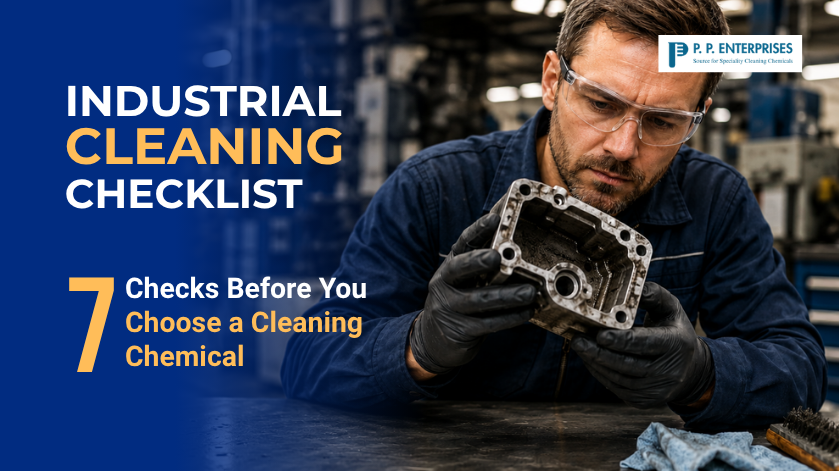
Industrial cleaning is not simply about choosing a stronger chemical. The right cleaning process depends on the contamination, component material, cleaning method, and what happens to the component next.
Whether you are removing oil and grease, carbon deposits, rust, scale, lapping paste, or other process residues, using the right cleaning approach can help improve surface preparation, reduce rework, and maintain consistent manufacturing quality.
This industrial cleaning checklist is designed to help maintenance teams, production engineers, quality teams, and industrial manufacturers evaluate their cleaning requirements before starting a cleaning process.
Quick Summary
Before selecting an industrial cleaning chemical, check these five things:
- Identify the contamination
- Understand the component and its surface
- Select the appropriate cleaning method
- Inspect the component after cleaning
- Protect the component before the next process or storage
The simple rule:
IDENTIFY → SELECT → CLEAN → INSPECT → PROTECT
Why Is an Industrial Cleaning Checklist Important?
Industrial components rarely have just one type of contamination.
Depending on the manufacturing process, a component may have:
- Oil
- Grease
- Carbon deposits
- Rust
- Mineral scale
- Lapping paste
- Metalworking residues
- Dust and shop-floor contamination
- Paint or coating residues
- Process chemicals
The challenge becomes greater when contamination is trapped inside grooves, recesses, holes, threads, corners, or other difficult-to-reach areas.
Choosing a cleaning chemical without first understanding the contamination and component can result in:
- Incomplete cleaning
- Excessive chemical consumption
- Longer cleaning cycles
- Manual rework
- Surface damage
- Production delays
- Poor surface preparation before plating or coating
That is why a structured cleaning assessment should come before chemical selection.
Industrial Cleaning Checklist
Use the following checklist before starting an industrial component cleaning process.
1. Identify the Contamination
Check all applicable contaminants:
- Oil
- Grease
- Carbon deposits
- Rust
- Mineral scale
- Lapping paste
- Paint or coating residue
- Dust or shop-floor contamination
- Other process residues
Why does this matter?
Different contaminants respond differently to different cleaning chemistries.
For example, a cleaning solution suitable for degreasing oil and grease may not be the appropriate choice for removing heavy carbon deposits, rust, or mineral scale.
The first question should therefore be:
What exactly am I trying to remove?
2. Understand the Component
The same cleaning chemical cannot automatically be applied to every industrial component.
Before selecting a cleaning process, identify:
- Component material
- Surface condition
- Presence of grooves
- Presence of recesses
- Internal holes or passages
- Threads
- Precision-machined surfaces
- Finished surfaces
- Existing corrosion
- Areas that are difficult to access
Pay special attention to complex geometries.
A component may appear clean on its external surface while contamination remains trapped inside a groove or recess.
This is particularly important for components that will subsequently undergo:
Electroplating | Painting | Coating | Assembly | Inspection
3. Determine the Required Cleaning Method
Once the contamination and component are understood, determine how the cleaning should be performed.
Ask:
- Is immersion cleaning required?
- Is ultrasonic cleaning appropriate?
- Is spray cleaning being used?
- Is manual cleaning required?
- Is alkaline cleaning appropriate?
- Is a low-pH cleaning process required?
- Does the application require a specialised industrial cleaning chemical?
Ultrasonic Cleaning
Ultrasonic cleaning can be particularly useful when components contain:
- Grooves
- Recesses
- Small holes
- Complex geometries
- Difficult-to-reach surfaces
Ultrasonic cavitation can help cleaning chemistry reach areas that may be difficult to clean manually.
However, the cleaning chemistry, concentration, temperature, time, equipment and component material all need to be considered together.
4. Select the Right Industrial Cleaning Chemical
This is where many industrial cleaning problems begin.
The objective should not be:
“Which is the strongest chemical?”
The better question is:
“Which cleaning chemistry is suitable for this contamination and component?”
Depending on the application, industrial cleaning requirements may involve:
Degreasers
For removing oils, grease and related contaminants.
Carbon Cleaning Chemicals
For carbon deposits and stubborn carbon-based contamination.
De-rusting Chemicals
For removing rust and oxidation from suitable metal surfaces.
Descaling Chemicals
For mineral deposits and water-scale-related contamination.
Alkaline Cleaning Chemicals
For suitable heavy-duty industrial cleaning applications.
Rust Inhibitors
For protecting cleaned metal components from corrosion during storage or before the next manufacturing stage.
5. Check the Cleaning Parameters
Selecting the right chemical is only one part of the process.
Before starting the cleaning cycle, check:
- Recommended concentration
- Cleaning temperature
- Contact or cleaning time
- Cleaning equipment
- Agitation or ultrasonic action
- Rinsing requirements
- Drying requirements
- Material compatibility
- Workplace safety requirements
Remember:
Chemical + Concentration + Temperature + Time + Mechanical Action = Cleaning Process
Changing one parameter can affect the final cleaning result.
6. Inspect the Component After Cleaning
Cleaning is not complete simply because the component looks cleaner.
After the cleaning cycle:
- Inspect the complete surface
- Check grooves and recesses
- Inspect holes and difficult areas
- Check for remaining oil or grease
- Check for carbon or process residues
- Confirm required surface condition
- Rinse where applicable
- Dry the component properly
Especially inspect components before:
Electroplating
Painting
Coating
Assembly
Welding
Quality Inspection
A component that is visually clean may still contain microscopic or difficult-to-see residues that can affect the next manufacturing process.
7. Consider What Happens After Cleaning
Cleaning is often only one stage in a larger manufacturing process.
Ask:
What happens to the component after cleaning?
Is it going directly to:
- Electroplating
- Painting
- Coating
- Assembly
- Inspection
- Packaging
- Storage
If the component will remain in storage before the next process, consider whether temporary corrosion protection is required.
The Industrial Cleaning Decision Checklist
Here is the complete checklist in one place.
Before Cleaning
- Contamination identified
- Component material identified
- Surface condition checked
- Grooves/recesses identified
- Difficult-to-reach areas identified
- Next manufacturing process identified
- Cleaning method selected
- Suitable cleaning chemical identified
During Cleaning
- Correct chemical concentration used
- Temperature checked
- Cleaning time controlled
- Equipment operating correctly
- Ultrasonic/agitation parameters checked where applicable
- Safety procedures followed
After Cleaning
- Surface inspected
- Grooves and recesses checked
- Residues checked
- Component rinsed where applicable
- Component dried
- Surface condition verified
Before the Next Process
- Suitable for electroplating/coating/painting/assembly
- No visible contamination remaining
- Storage requirements considered
- Corrosion protection considered where required
A Simple Industrial Cleaning Decision Tree
Is the contamination known?
NO → Identify the contamination before selecting the chemical.
YES → Continue.
Is it oil or grease?
YES → Evaluate a suitable industrial degreasing process.
Is it carbon or heavy deposit?
YES → Evaluate a suitable carbon cleaning chemical.
Is it rust?
YES → Evaluate a suitable industrial de-rusting chemical.
Is it mineral scale?
YES → Evaluate an appropriate descaling process.
Does the component have grooves, recesses or complex geometry?
YES → Evaluate whether ultrasonic or another suitable mechanical cleaning method can improve the process.
Is the component going for electroplating, painting or coating?
YES → Give particular attention to final surface cleanliness and residue removal.
Common Industrial Cleaning Mistakes
1. Choosing the Chemical Before Identifying the Contamination
A chemical that works well for grease may not be suitable for carbon, rust, scale or lapping paste.
2. Assuming Stronger Means Better
Increasing chemical strength without considering the component material, concentration, temperature and process requirements can create unnecessary risks.
3. Checking Only the Visible Surface
Contamination can remain inside grooves, recesses, holes and other difficult-to-reach areas.
4. Ignoring the Next Manufacturing Process
A component may be sufficiently clean for one application but not sufficiently clean for electroplating, coating or painting.
5. Ignoring Drying and Temporary Protection
Clean metal components can be vulnerable to corrosion if they are exposed to moisture before the next process.
How PP Enterprises Helps With Industrial Cleaning Applications
Industrial cleaning is application-specific.
At PP Enterprises, industrial cleaning solutions are available for different contamination and manufacturing requirements, including:
- Carbon cleaning
- Degreasing
- Rust removal
- Rust prevention
- Descaling
- Alkaline cleaning
- Immersion cleaning
- Ultrasonic cleaning applications
- Engine cleaning
- Industrial component cleaning
The objective is not simply to supply a chemical.
The objective is to identify the contamination, component, cleaning method and required end result and then determine an appropriate cleaning approach.
Related Industrial Cleaning Solutions
If you are looking for a specific industrial cleaning application, explore the relevant PP Enterprises solutions:
- Industrial Carbon Cleaning Chemicals — for carbon and heavy deposits
- Immersion Cleaning Chemicals — for suitable immersion cleaning applications
- Industrial De-rusting Chemicals — for rust and oxidation removal
- Industrial Alkaline Cleaning Chemicals — for suitable heavy-duty cleaning applications
- Industrial Rust Inhibitors — for temporary corrosion protection
- Radiator Cleaning Chemicals — for radiator and cooling-system cleaning
- Industrial Engine Cleaning Chemicals — for engine and engineering applications
Frequently Asked Questions
An industrial cleaning checklist is a structured set of checks used to identify contamination, understand the component, select an appropriate cleaning method, control the cleaning process, inspect the result, and prepare the component for its next manufacturing stage.
Start by identifying the contamination and component material. Then consider the cleaning method, concentration, temperature, cleaning time, equipment, surface requirements, and the next manufacturing process.
Industrial carbon cleaning chemicals are formulated for removing carbon deposits and stubborn carbon-based contamination. The appropriate product depends on the type of deposit, substrate, cleaning equipment and process requirements.
Ultrasonic cleaning can be useful for components with grooves, recesses, holes and complex geometries because ultrasonic cavitation can assist the cleaning solution in reaching difficult areas. The chemistry and process parameters still need to be appropriate for the application.
Proper cleaning and surface preparation help remove oils, grease, process residues and other contaminants that may interfere with subsequent electroplating operations.
Degreasing primarily targets oils, grease and similar contaminants, while carbon cleaning is intended for carbon deposits and stubborn carbon-based residues. The correct chemistry depends on the actual contamination.
Not necessarily. Component material, surface finish, contamination and cleaning conditions all need to be considered when selecting an industrial cleaning chemical.
Inspection helps confirm that contamination has actually been removed, including from grooves, recesses and other difficult-to-reach areas, before the component moves to the next manufacturing stage.